



Key Takeaways
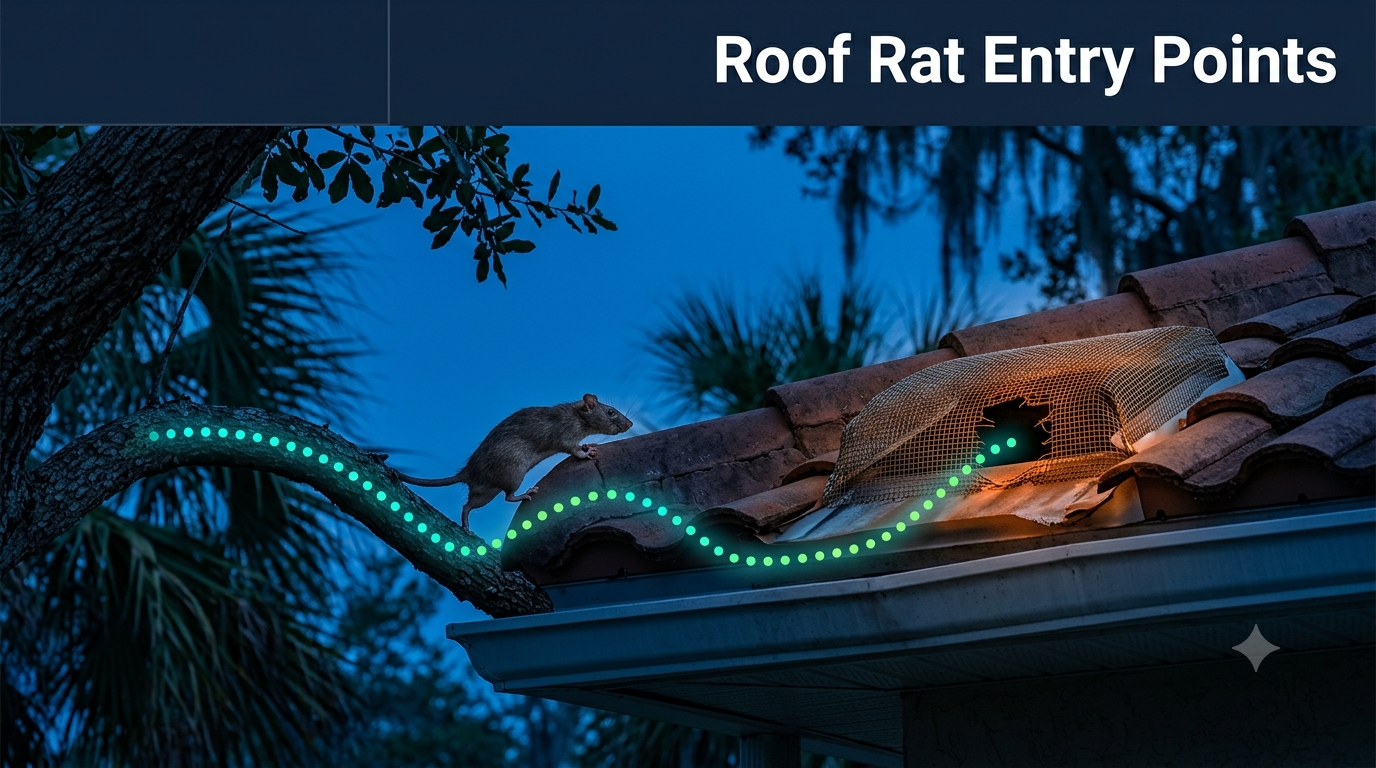
- Roof rats often enter homes through existing gaps around soffits, roof vents, utility lines, and damaged roof edges.
- Overhanging trees and connected branches can create access routes to elevated openings.
- Droppings, gnaw marks, and attic noises help identify activity, but the entry point must be verified separately.
- Rodent exclusion in Polk County hinges on finding out how the rodents got in, removing the animals, and securing the premises.
Finding scratching sounds above the ceiling can leave homeowners wondering how rats got inside in the first place. In Lakeland and Winter Haven, roof rats can take advantage of elevated openings, gaps around roof structures, and branches that connect nearby trees to a house.
Unlike rodents that primarily travel along the ground, roof rats are agile climbers. They can move along branches, fences, utility lines, and roof edges before entering an attic or wall cavity. The University of Florida’s roof rat guidance explains that these rodents commonly occupy attics, soffits, and hollow walls, making upper portions of a building important areas to inspect.
The challenge is that the place where rats are heard is not necessarily where they entered. A rat may use an opening near the roofline, travel along framing, and leave droppings several feet away. Identifying the full route helps homeowners address the cause instead of repeatedly treating the symptoms.
1. Inspect Soffits, Fascia, and Roofline Gaps
Soffits cover the underside of roof overhangs, while fascia boards run along the roof edge. Gaps around these components can provide access to attic spaces, particularly when materials have loosened, deteriorated, or separated at a joint.
During an inspection, pay attention to:
- Seams where soffit panels meet fascia boards or exterior walls.
- Loose panels, warped sections, and damaged trim.
- Gaps near roof corners and where additions meet the main structure.
- Dark rub marks, gnawing, or debris near a suspected opening.
It might be hard to spot from the ground. For a preliminary visual survey, use binoculars, but never climb onto a roof or disturb suspected nesting areas without taking safety precautions.
An easeful distinction is between the gap that is created in the building and the gap that is demonstrated by animals. If in combination with a rub mark, close to the dropping or a similar trail of attic activity, then it is more evidence.
2. Check Roof Vents and Other Openings
Roof vents, gable vents, and attic ventilation openings can become entry points when screens are damaged, missing, or poorly secured. Roof rats may also exploit gaps where pipes, cables, or other utilities pass through exterior walls and roof sections.
Inspect these areas for:
- Torn or displaced vent screening.
- Loose vent covers or damaged protective grilles.
- Unsealed spaces around plumbing and electrical penetrations.
- Gaps around roof intersections and older repairs.
The repair must preserve the component’s intended function. For example, blocking an attic vent completely may interfere with ventilation and contribute to moisture problems. Exclusion materials should be durable and suited to the opening, with ventilation and drainage requirements maintained.
While it is a good idea to use expanding foam around all visible gaps, it is not a comprehensive repair. All of the material, its opening size, where it is located and how exposed it is to gnawing is important. A repair should be permanent rather than only temporary as rats can reopen.
3. Trace Tree Branches and Exterior Travel Routes
Trees can give roof rats a route to parts of a house that would otherwise be difficult to reach. Branches touching or extending over the roof deserve particular attention, along with vines, fences, and nearby structures that provide connected travel paths.
This particularly applies when visiting houses in Lakeland and Winter Haven that have established trees or other fruit-producing plants. But, if rats are in a home, there is no way to tell if they are coming from nearby trees.
Check for a full set of clues, a potential climbing path, an opening that can be accessed in the roofline, and signs of activity within. Trimming branches from the structure will decrease access but not eliminate an infestation if there is another opening available.
4. Use a Three-Point Method to Verify Entry
Finding a hole is only the beginning. A more useful inspection connects three kinds of evidence before deciding what to repair.
| Verification point | What to examine | Why it matters |
| 1. Access route | Branches, utility lines, roof edges, and connected structures | Identifies how rats could reach the building |
| 2. Physical evidence | Rub marks, gnawing, droppings, disturbed screening, or debris | Helps determine whether an opening may be in use |
| 3. Interior activity | Attic noises, droppings, damaged insulation, or travel marks | Connects the suspected opening with activity inside |
No single clue confirms an entry point. For example, a damaged soffit may be old, while fresh droppings elsewhere may indicate a different route. Inspectors should compare the exterior opening with the location and pattern of interior evidence.
5. Why Roof Rat Removal Must Include Exclusion
The control of rats is designed to catch or eliminate the rats already in the area, but it does not guarantee that the rats will not enter the area again. If the opening still exists, there could be a repeat problem.
There should then be 3 related tasks in a professional roof rat removal in Lakeland: Identify and remove any active rodents, fix any verified entry points, and inspect for any remaining vulnerabilities. Insulation in the attic, wiring and stored items also warrant inspection for contamination or damage.
Homeowners should never reach into hidden areas, use bare hands to pick up animals that have dropped in, or close an opening before verifying that animals are not still trapped. Cleanup and repairs must be carried out in accordance with the safety requirements.
For homeowners dealing with rats in attic spaces in Lakeland or suspected rat entry points in Winter Haven, a thorough inspection can clarify where access occurs and which repairs are necessary. Critter Control® of Polk County provides local wildlife and rodent services. Visit Critter Control of Polk County to learn more about inspection and removal options.
Contact Polk County Wildlife Experts
Common locations include gaps around soffits and fascia, damaged attic vents, roofline joints, and openings around utility penetrations. Overhanging branches may also give rats access to these areas.
Scratching sounds, droppings, damaged insulation, gnaw marks, and disturbed vent screening can indicate rodent activity. A professional inspection can help connect these signs to a likely exterior entry route.
Yes. Roof rats can use surprisingly small gaps, so an opening that appears insignificant from the ground should not be dismissed. The exact opening size that can be used depends on the animal and the condition of the gap.
Trimming branches that touch or overhang the roof can reduce access routes. However, rats may still enter through vents, roofline gaps, or utility openings, so landscaping changes should be combined with a structural inspection.
Rodent exclusion involves locating accessible openings, removing or managing the animals inside, and sealing entry points with suitable materials. A complete approach also considers ventilation, existing damage, and other vulnerable areas that could allow rats to return.